AI in crisis management: where are the real gains?
- Crisis management
- Safety region
- Training and exercises
- AI in government
- Crisis communication
- BCM
- Generative AI
- AI literacy
- Public sector
Generative AI offers crisis organisations real opportunities, from Dutch safety regions and regional medical emergency services to hospitals, water authorities and business continuity (BCM) teams. But the risks differ sharply by application. In preparation, which the Dutch call OTO (training, drilling and exercising), the gains are already large: generating scenarios, writing plans, producing course material, speeding up evaluations. In live operations the potential is even greater, but so are the risks: hallucination, data leaks, automation bias. If you start with training and exercises now, train by role and set policy on data and tooling, you build a foundation that operational applications can later rest on safely.
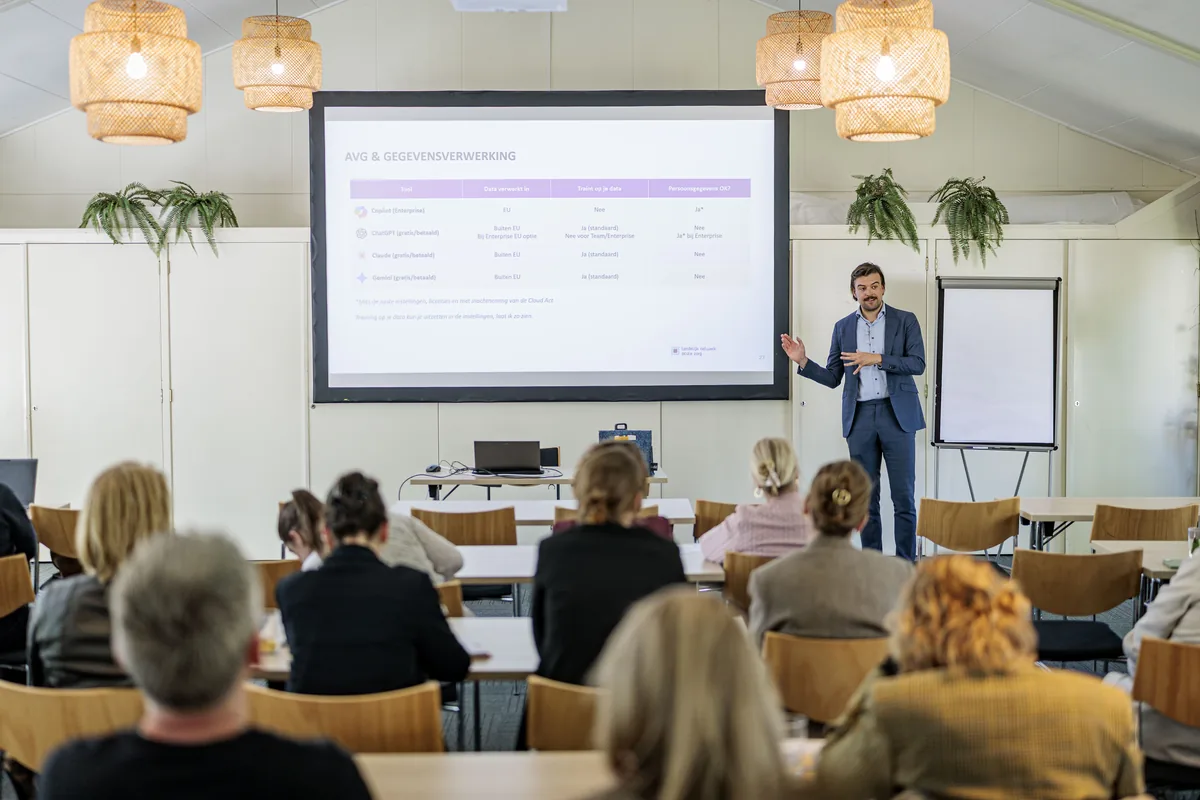
Over the past months I have spent a lot of time in the crisis management world. With the training and exercise team of Veiligheidsregio Twente, one of the 25 Dutch safety regions that coordinate fire, medical and public order response, I am exploring how generative AI can strengthen training, drilling and exercising. At sessions of the Landelijk Netwerk Acute Zorg, the Dutch national acute care network, I spoke with care coordinators, officers from GHOR (the regional medical emergency organisation) and representatives of trauma centres and hospitals. In wider conversations, roles such as head of information, recovery-phase adviser, incident commander and head of communications joined the table.
In all those conversations I see two worlds where AI has something to add: preparation (training and exercises) and live operations. They demand fundamentally different things. And that difference matters.
Preparation: training, drills and exercises
This is where most of the low-hanging fruit is right now. Not because the work is simple, but because the risks are manageable: you have time to validate, review and adjust.
Generating scenarios with variation
A good exercise stands or falls with realistic, varied scenarios. In practice I see exercise leaders often fall back on a small set of familiar cases, simply because writing a good scenario takes a lot of time. With generative AI you can generate dozens of variants per exercise: the same basic shape, but with different locations, weather, times of day, casualty numbers, communication problems or political complications. The work shifts from writing to curating.
One important point: the prompt has to impose structure. We work with a format in which the same elements always return (situation, people involved, complicating factors, learning objectives, desired response). Without that structure you get Hollywood scenarios. With it, you get exercise material.
Plans, course material, knowledge checks
In our own training practice we produce a lot of material: course outlines, exercises, knowledge checks, handouts. With well-designed prompts and your own source material (protocols, response plans, past evaluations) this goes an order of magnitude faster. Provided you read the output critically and have a subject-matter expert check it. The crux is not the model, but the sources you feed it and the review process that follows.
Debriefing and evaluation
An underrated application. After an exercise or a real deployment there are often transcripts, logs, printouts from LCMS (the Dutch national crisis management information system) and evaluation forms. An AI model can help spot patterns, cluster recurring bottlenecks and draft improvement points. The evaluator stays responsible, but the analytical groundwork goes faster. That is valuable, because there is usually no time for a thorough evaluation.
Live operations: more potential, a higher bar
This is where it gets more interesting and, at the same time, harder. Talk to heads of information, incident commanders or recovery advisers and you hear the same wishes: during and after a deployment you want faster situational awareness, faster forward scenario thinking, and a faster link to earlier cases. AI can contribute to that.
What would be truly valuable?
Applications I hear about often:
- Real-time summaries of incoming reports and LCMS entries, so the head of information can make sense of the picture faster without losing essential details.
- Forward scenario thinking: given this situation, what developments are likely in the next 1, 4 or 24 hours? Which conditions are missing?
- Comparison with past deployments: does this case resemble something from the past? Which decisions were taken then, and with what effect?
- Crisis communication and briefings for decision-makers: how do you turn an operational situation, at speed, into messages for the public, press releases and briefings for the “triangle” (in the Netherlands, the mayor, the chief public prosecutor and the police chief)? Crisis communication is one of the places where time pressure and quality clash hardest, and that is exactly where a good first draft can be worth a lot. Not as a replacement, but as a basis the team only has to validate and sharpen.
- Support in the recovery phase: for recovery advisers the challenge is usually not the first 24 hours, but the months that follow. Merging victim registrations, anonymised pattern recognition in care requests, drafts for remembrance communications, reports to the board. Work where AI can take over a lot of preparation, so the adviser can keep doing the human side.
Less obvious applications
This, to me, is where the truly interesting space lies:
AI as an active opponent in exercises. In the wargaming tradition the opponent is a fixed part of the game: someone who actively pushes back and puts the scenario under pressure. An AI model can fill that role in tabletops and staff exercises, with unexpected twists, media pressure, or a critical official asking awkward questions. Not as a replacement for human exercise control, but as reinforcement.
Synthetic roles for more realistic exercises. Press questions, worried relatives, a social media storm, an irritable official, a spokesperson from another country. All roles that are often missing in exercises or are played by one person. With AI you can run them in parallel and raise the pressure realistically.
AI as devil’s advocate in decision-making. One of the biggest risks in a crisis staff is groupthink under time pressure. An AI model with a specific brief (“give the strongest counter-argument against the current course, with reasoning”) can help break that reflex, if the culture allows it.
Pre-mortem on an ongoing deployment. Suppose that in six hours this has spun completely out of control. How did that happen? A short AI-driven pre-mortem forces the team to name risks explicitly that would otherwise stay implicit. Small in scope, quick to run, often surprisingly instructive.
Briefing assistant for officials who join later. A mayor or the chair of a water authority who gets a call at 02:00 wants to be up to speed within 90 seconds. A well-structured briefing based on the LCMS log can add a lot of value there.
Why this is not easy (yet)
A few hard conditions you cannot get around:
Hallucination is unacceptable in a crisis. A made-up detail in a marketing text is annoying. A made-up detail in an operational briefing can cost lives. Applications for live operations must be designed for that: with source references, explicit marking of uncertainty, and human verification as a mandatory step in the process.
Data must not leave the organisation. LCMS data, personal data of people involved, sensitive information for decision-makers: none of it goes to a public chat service. This calls for Azure, on-premises or sovereign cloud solutions with the right data processing agreements under the GDPR, plus a check on the EU AI Act obligations that apply to these applications. That is not a technical detail, it is a precondition.
Integration over standalone tools. An AI button inside LCMS or inside your own crisis environment has fundamentally different value from an AI tool in a separate window. During a deployment the crisis manager has no time for copy-paste, and you do not want operational information ending up in loose tools you have no oversight of.
People often work for several organisations. This came up in every session and is underestimated. Many crisis officers have a main employer plus an on-call duty or second role at a safety region, hospital, municipality or another partner. If you want to use AI structurally in crisis management, you will need access models that follow a person’s role, not just their employment contract.
Responsibility stays with people. AI is a tool for the officer, not a replacement. That must be explicit in education and training too. Without that awareness you get automation bias at exactly the wrong moments.
Not just safety regions
Much of the above applies more widely than classic crisis management. Crisis and continuity management plays a role in many sectors:
- Water authorities (high water, drought, dyke monitoring, water quality)
- Drinking water companies and grid operators (outages of electricity, gas, telecoms, drinking water)
- Rail and airports (ProRail, NS, Schiphol, air traffic control)
- Ports and logistics hubs
- Hospitals and care chains (scaling up, outages, infection control), see also our AI training for healthcare
- Municipalities and provinces (care for the population, public order), see also our AI training for municipalities and for public sector policy makers
- Large companies and critical infrastructure with a BCM function
Especially in BCM, specifically scenario analysis, impact assessments, recovery plans and exercise cycles, many of the same patterns apply. Different words, similar work. And similar chances to use AI to exercise, document and evaluate faster, more broadly and with more variety. The same holds for crisis and continuity teams in Belgium, Luxembourg and elsewhere in the EU.
What would I advise crisis and continuity organisations?
A few concrete steps that make sense right now:
- Start with training and exercises. Lower risks, a fast learning curve, directly applicable. Build internal experience there, develop prompts and ways of working, and learn what does and does not work in your context.
- Train the people who actually have to use it. An incident commander, a head of information, a communications adviser, a recovery adviser or a BCM coordinator each have very different questions. Generic AI training falls short here. That is why we build tailored training.
- Set policy on data and tooling, with an eye on the multi-organisation reality. Which information may go into which tool? Which suppliers are approved? And how do you make sure someone who is on call for you but works elsewhere actually has access to the right things? Without this policy, shadow AI appears. We support organisations here with AI policy consulting and broader implementation consulting.
- Talk to your system suppliers. LCMS, dispatch systems and other crisis systems will add AI features at some point. As a user, make sure you help shape what they should do, and what they should not.
- Build in evaluation from the start. What time savings, what quality gains, what unexpected effects? Without measurement there is no learning, and no case for further investment.
Finally
What strikes me most in all these sessions: the willingness and professional curiosity in crisis management are high. People see the opportunities, ask sharp questions, and are realistic about the risks. That is a good starting position. The pace at which the technology moves does call for an active stance: waiting means the tools will be used anyway, only without a framework.
Together with my colleague Diederik Stolk I work on these questions at AI Advice & Training. Diederik brings years of experience in serious games, wargaming and crisis management, alongside practical knowledge of generative AI. A combination that comes in handy in this field.
Responses, critical counterpoints or examples from your own practice are welcome. Want to explore what this could mean for your organisation? Get in touch or look at our AI training for crisis organisations.
Frequently asked questions
What does AI in crisis management mean? By AI in crisis management we mean using generative AI (such as ChatGPT, Microsoft Copilot, Claude or Gemini) within crisis organisations: safety regions, regional medical emergency services, acute care networks, hospitals, municipalities, water authorities, grid operators and BCM departments. Applications range from drafting exercise scenarios and response plans to support with real-time situational awareness, forward scenario thinking and the recovery phase.
Where can a safety region already use AI safely? In preparation (training, drills and exercises) the risk is manageable because there is time for validation. Concrete applications: generating scenarios with variation, drafting response plans, producing course material and knowledge checks, and speeding up debriefings or evaluations by spotting patterns in logs and evaluation forms.
What are the risks of AI in an operational crisis? The four main ones: hallucination (made-up details can cost lives), data leaks (sensitive information must not go to public chat services), automation bias (too much trust under time pressure) and fragmented tooling across the organisations the same officers work for. For operational use, source references, uncertainty marking and human verification are preconditions, not optional extras.
What is OTO in a Dutch safety region? OTO stands for Opleiden, Trainen en Oefenen: education, training and exercising. It is the preparation side of a Dutch safety region, where crisis officers are trained and keep their skills up to date. Generative AI can save a lot of time in this phase on content production and scenario development.
How does this relate to Business Continuity Management (BCM)? BCM in companies and critical infrastructure uses similar building blocks to public crisis management: scenario analysis, impact assessments, recovery plans, exercise cycles. The generative AI applications described above broadly carry over to BCM teams.
Which crisis organisations benefit most from AI? All organisations with a clear training and exercise cycle and a large volume of written work: safety regions, regional medical emergency services, acute care networks, hospitals, water authorities, drinking water companies, grid operators, municipalities and provinces, and private BCM departments. If you are responsible for scenarios, response plans, exercise material or evaluations, you will usually see an effect within a few weeks.